How much does web hosting cost? Real prices for 2026
Web hosting costs $2 to $4 a month for an entry shared plan in its first term and $8 to $18 a month once it renews, as of 10 Oct 2026. A small VPS runs $4 to $6 a month at flat rates, managed WordPress starts near $30, and a dedicated server about $117. Here is every tier priced three ways: intro, renewal and three-year total.
The renewal number is the one to budget with. A site usually lives for years, and on most cheap plans the promotional rate covers only the first term. Hostinger's Single plan, for instance, costs $1.99 a month but only when you prepay 48 months ($95.52 upfront), and it renews at $8.99. DreamHost's Launch plan is $2.89 a month for one prepaid year, then auto-renews at $10.99. Those two plans look almost identical on a banner and behave very differently over three years.
This page gives the short answer first, then the full cost ladder from shared hosting to dedicated servers, a three-year view of the renewal cliff, the add-ons that inflate a cheap bill, and three realistic budgets. Every price was read on the host's own US pricing page on the date shown, and every total is our arithmetic, before sales tax.
The short answer: what web hosting costs per month
- Shared hosting: $1.99 to $4 a month on intro terms, $8 to $18 a month on renewal.
- Unmanaged VPS: about $4 to $6 a month for 0.5 to 1 GB of RAM, billed monthly at the same rate.
- Cloud and managed VPS: $14 a month and up for managed cloud, $55 to $59 a month for a managed VPS once promos end.
- Managed WordPress: from $30 a month on an annual plan at the premium end.
- Dedicated servers: from about $117 a month plus a setup fee, and $249 a month and up for fully managed.
If you only need a blog, a portfolio or a brochure site for a small business, shared hosting is enough, and the realistic long-run price is the renewal: roughly $96 to $216 a year for the plan alone. The rest of this page explains where those numbers come from and how to land at the low end of them.
Web hosting prices by type: intro, renewal and 3-year total
The table below lines up one or two representative plans per tier. "3-year cash" is everything you would pay in the first 36 months on the advertised path, with no coupons and before tax. Where the advertised price needs a 48-month prepay, the upfront payment already covers the whole three years, and we say so.
| Tier and plan | Intro price and term | Renewal | 3-year cash |
|---|---|---|---|
| Shared: Hostinger Single | $1.99/mo, 48-month prepay ($95.52) | $8.99/mo | $95.52 (covers 48 months) |
| Shared: Hostinger Premium | $2.99/mo, 48-month prepay ($143.52) | $10.99/mo | $143.52 (covers 48 months) |
| Shared: DreamHost Launch | $2.89/mo, 1-year prepay ($34.68) | $10.99/mo | $298.44 |
| Shared: IONOS Essential | $4/mo, 1-year term | $8/mo | $240 |
| Shared: GreenGeeks Lite | $2.95/mo, 12-month prepay ($35.40) | $13.95/mo | $370.20 |
| Unmanaged VPS: DigitalOcean 1 GiB | $6/mo, billed per second | $6/mo (flat) | $216 |
| Unmanaged VPS: Vultr 1 GB | $5/mo | $5/mo (flat) | $180 |
| Cloud: Hostinger Cloud Startup | $7.99/mo, 48-month prepay ($383.52) | $25.99/mo | $383.52 (covers 48 months) |
| Managed cloud: Cloudways Micro (1 GB, DigitalOcean) | $14/mo, billed hourly | Same rate | $504 |
| Managed VPS: ScalaHosting Build #1 | $29.95/mo, 1-year prepay ($359.40) | $54.95/mo | $1,678.20 |
| Managed WordPress: Kinsta Single 35k | $30/mo billed annually ($35 monthly) | Same rate | $1,080 |
| Dedicated: Hetzner AX42 | $117.10/mo + $59 setup | Same rate | $4,274.60 |
| Managed dedicated: Liquid Web | From $249/mo | Not stated | $8,964 |
Three things jump out. First, the cheapest three-year path is a long prepay with a host you are confident in: Hostinger Single's $95.52 covers 48 months, while a one-year deal at a similar sticker price costs three times as much by year three. Second, unmanaged VPS pricing is refreshingly flat. DigitalOcean, Vultr and Hostwinds publish one monthly rate, with no intro discount and no renewal jump, so the three-year total is just 36 times the monthly price. Third, the jump from self-managed to managed is the biggest price step in hosting. The cheapest managed VPS in the table renews at about nine times the price of DigitalOcean's 1 GiB unmanaged server. The specs differ, but most of that gap is the cost of someone else's time.
The renewal cliff in one chart
The chart splits each shared plan's three-year cash into what you pay in year one and what you pay in years two and three. The short brass segment is the advertised deal; the long red segment is the renewal you agreed to without noticing.
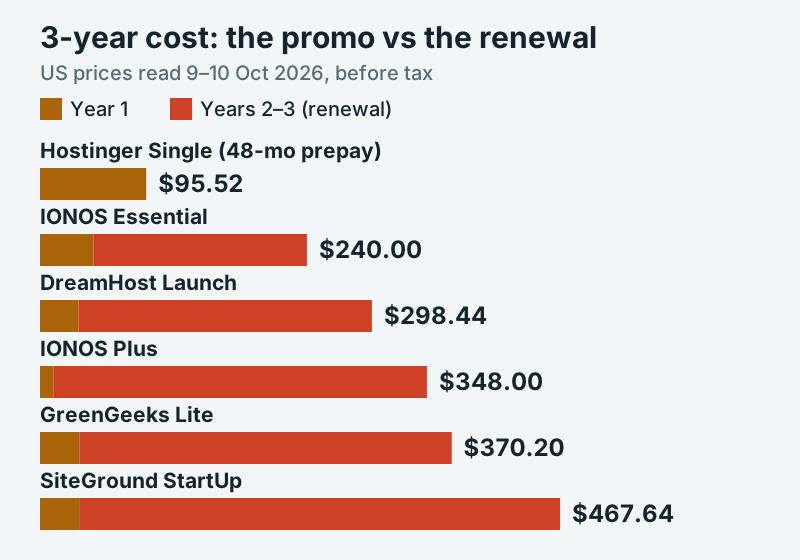
The pattern holds across hosts: a low intro price on a one-year term means the renewal carries most of the three-year bill. IONOS Plus is the extreme case, at $1 a month for a year and $14 a month after, so 97% of its three-year cost lands after the promo ends. That is not a reason to avoid it; it is a reason to compare plans on what they cost in year three, not in month one. Our true-cost calculator runs the same arithmetic for any plan and term you type in.
If you want the lowest three-year cash outlay among the plans above and can commit for four years, Hostinger's 48-month terms win. If you would rather keep a one-year commitment, IONOS Essential has the smallest renewal on the list at $8 a month, and DreamHost Launch gives you 25 websites for the same $10.99 renewal as Hostinger Premium.
How monthly costs climb by hosting type
Shared hosting is cheap because hundreds of accounts share one server's CPU and memory. Each step up the ladder buys more guaranteed resources or more management, and the price rises in large jumps rather than gradually.
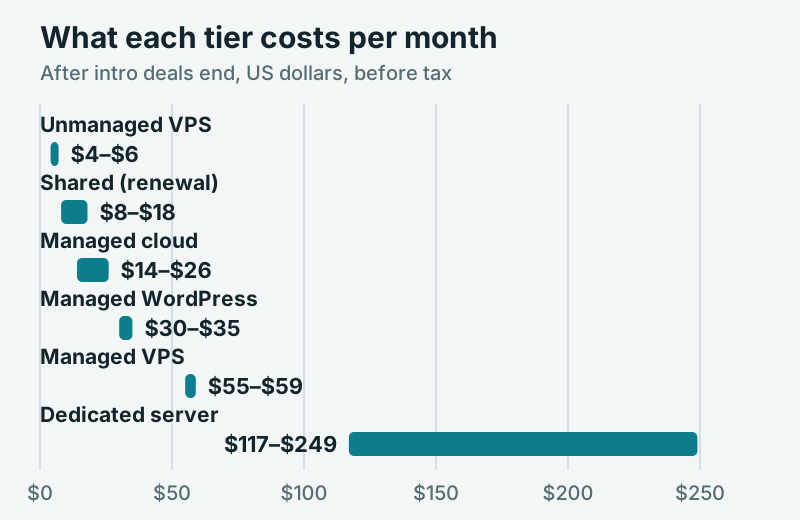
The chart uses the price you pay after any promotion, because that is what the tier really costs. Unmanaged VPS sits below shared renewals here, which surprises people: a $6 DigitalOcean server with 1 GiB of memory costs less per month than most shared plans on renewal. The catch is that nobody manages it for you. You install the web server, apply security updates and fix it at 2 a.m. If that sounds like a hobby you enjoy, a VPS is the best value in hosting. If it does not, the managed tiers are where your money goes.
The add-ons that double a cheap bill
The plan price is rarely the whole invoice. These are the lines that most often appear on the real bill, with the published prices we could confirm.
| Add-on | What is included | Published price after that |
|---|---|---|
| .com domain | Free for year one with most shared plans | $20/yr at IONOS; $19.99/yr per Hostinger's own guide; $10.88/yr at Dynadot |
| Hostinger Premium: 2 mailboxes/site for 1 year; DreamHost Launch: 20 mailboxes for 3 months | Separate subscription; Zoho Mail Lite from $1/user/mo (annual) | |
| Backups | Daily on DreamHost and GreenGeeks entry plans; weekly on Hostinger Premium | DigitalOcean VPS: +20% of server price weekly, +30% daily |
| SSL certificate | Free certificates are standard on shared plans; GoDaddy Economy lists SSL free for year one only | Should be $0; skip paid SSL upsells |
| Setup fee | Not listed on the shared pricing pages we read | Hetzner dedicated: $59 one-off on AX42 |
The domain is the add-on almost everyone pays. A first-year domain is usually bundled, and from year two the host bills its own renewal rate: $20 a year at IONOS and $19.99 at Hostinger, according to their own price lists, against $10.88 for registration and renewal alike at a registrar such as Dynadot. Over five years that gap is about $40, for the same name.
Email is the second. Hostinger bundles two mailboxes per site with Premium, free for twelve months; DreamHost's Launch comes with 20 mailboxes at no charge for the first three months. After that, mail becomes a separate subscription. If you need a few business addresses, a standalone service can be cheaper: Zoho's Mail Lite plan lists $1 per user a month on annual billing (read 9 Oct 2026).
Backups are the third, and the one people discover after a disaster. DreamHost and GreenGeeks list daily automated backups on their entry plans. Hostinger's Premium plan lists weekly backups, and its hosting agreement keeps two weeks of history. On a VPS, backups are a paid toggle: DigitalOcean charges 20% of the server's price for weekly backups and 30% for daily ones. SSL, by contrast, should cost nothing: a free certificate is standard on mainstream shared hosting, and DreamHost's web hosting comes with a free SSL certificate. One exception worth knowing: GoDaddy's Economy plan lists its SSL certificate as free for one year only.
What a realistic budget looks like: three example sites
Prices below come from the table and the add-on list above. Each example uses one sensible configuration, not the only one.
A personal blog or portfolio
Hostinger Single on the 48-month term, with the domain registered separately at a flat-price registrar so the renewal never jumps. Year one: $95.52 for hosting plus $10.88 for the domain, $106.40 in total. Year three: $10.88, because the hosting is already paid. Year five is when the plan renews at $8.99 a month, so diarise it.
A small-business brochure site with email
IONOS Essential on its one-year term, with the free first-year domain and the included mailbox. Year one: $48. From year two: $96 for hosting plus $20 for the .com renewal, $116 a year. Add two Zoho Mail Lite users at $24 a year if one mailbox is not enough.
A growing site on a small server
A DigitalOcean Basic Droplet with 2 GiB of memory at $12 a month, weekly backups at $2.40 (20%), and a $10.88 domain. That is $183.68 a year from day one, with no renewal surprise, but you maintain the server yourself. The same budget on managed shared hosting would buy a higher tier with support included; pick by whether you want control or convenience.
Hosting prices are not standing still
Two changes in 2026 show why a dated price matters. Hetzner, long the reference for cheap servers, adjusted its cloud prices on 1 April and again on 15 June 2026: its entry CX23 server went from €3.99 to €5.49 a month, and the dedicated-vCPU CCX13 from €15.99 to €42.99, according to its own price-adjustment notice. Its US-region CPX11 rose from $6.99 to $20.49. Anyone who budgeted from a 2025 review is now out by a wide margin.
The other change runs the opposite way. Since New Year 2026, DigitalOcean has charged its servers by the second (one minute minimum), so a test server that runs for an afternoon costs cents rather than a full hour's rounding. For short experiments, that makes a real server cheaper than any shared plan's monthly minimum.
The lesson for budgeting is simple: treat any hosting price older than a few months as a guess, and re-check the renewal figure on the host's own page on the day you buy. Every number on this page carries its read date for that reason.
How to pay less for hosting, legally
The cheapest hosting is a cheap plan whose renewal you have already accepted. A few habits get you there.
- Match the term to your certainty. A long prepay gives the lowest price per month, but only if the site and the host both last. Our guide to paying monthly versus prepaying works through the break-even.
- Use the refund window. Hostinger, DreamHost, GreenGeeks and IONOS each publish a 30-day money-back period for hosting. Test the host properly inside it.
- Check the renewal before you buy, not after. Our explainer on why cheap hosting renews expensive shows where the number hides on each pricing page.
- Downgrade at renewal. If a plan's extra sites or storage went unused, renew on the smaller tier; the price drop applies to every year after.
- Keep the domain at a registrar with a flat price, so a hosting switch never puts your name at risk.
For a ranked shortlist sorted by long-run cost rather than the banner price, see our best cheap web hosting page, and for the fees we have caught hosts adding at checkout, our list of cheap hosting hidden fees.
Edge cases that change the price
- Taxes: every price here is before sales tax or VAT. Hetzner's and DreamHost's pages both state that tax is added at checkout.
- Currency and region: hosts price by country. A reader outside the US may see different numbers on the same page.
- Visitor guides are not caps, until they are: DreamHost sizes Launch for about 40,000 monthly visits and says it is a guide, not a hard limit, but heavy overuse can mean an upgrade request.
- "Unlimited" plans still have resource limits in the small print, so a busy site may be pushed up a tier sooner than the banner suggests.
- Promotions move. Black Friday sales and coupon codes can undercut every intro price here for a few weeks a year, though the renewal stays the same.