Unlimited Web Hosting Explained: The Real Caps Behind the Plans
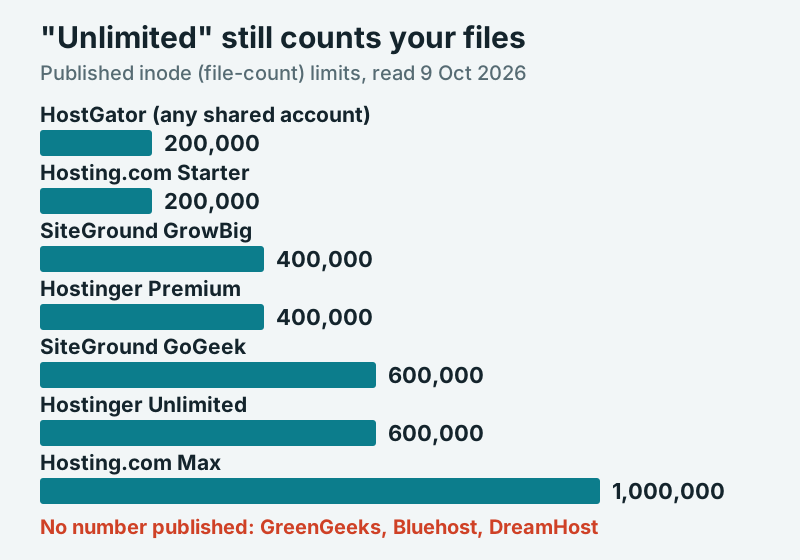
No, unlimited web hosting is not unlimited. "Unlimited" on a shared plan usually means the host does not meter one or two things, such as the number of websites or the bandwidth, while CPU time, memory, file counts and database sizes stay capped in the terms of service. Hostinger's Unlimited plan, for example, comes with 2 CPU cores, 3 GB of RAM and a 600,000-file limit in Hostinger's own documentation.
That is not a scandal; shared servers have to divide finite hardware somehow. The problem is that the real limits sit in a knowledge-base article or a legal page, not on the plan card, so two "unlimited" plans can differ by a factor of two or more in what they actually allow. This guide pulls those caps out of each host's own pages into one table, read on 9 Oct 2026, and explains what happens when a site hits them.
Where the limits actually live
A shared hosting account is a slice of one physical server. To stop one busy site from slowing down hundreds of neighbours, hosts cap each account's share. A common tool for this is CloudLinux, whose documentation lists the standard levers: SPEED (CPU), PMEM and VMEM (memory), EP (entry processes, roughly the number of simultaneous PHP requests), NPROC (total processes), IO and IOPS (disk throughput and operations), plus inodes, which count every file and folder in the account.
"Unlimited" marketing describes what the host chooses not to meter. The fine print describes everything it does. Hostinger's hosting agreement ties "unlimited" to what an ordinary small-business site would use. Hosting.com's service terms define it by comparison with similarly situated customers. Both phrasings mean the same thing: normal use is fine, unusual use is not, and the host decides which is which.
The five caps that bite
- Inodes: every file, image thumbnail, email and cache fragment is one inode. A WordPress site with years of uploads, a busy mailbox and a caching plugin can reach six figures without anyone noticing.
- CPU time: measured in cores or in CPU-seconds. SiteGround publishes CPU-seconds per hour, per day and per month for each plan.
- Memory: the RAM your PHP processes can use at once. A page builder, a store or a heavy plugin stack runs into this first.
- Concurrent processes or connections: how many requests the account can handle at the same moment. Hosting.com's terms cap shared accounts at 35 concurrent HTTP connections.
- Database size: often a separate ceiling. DreamHost sets a hard 3 GB limit per MySQL database, and HostGator may restrict any single database above 5 GB.
None of these appears on a typical plan card, and none is "unlimited" on any plan we checked.
Each host's published limits on its unlimited plans
Below, for every plan marketed with unlimited websites, storage or bandwidth, are the caps its host puts in writing. Where a host publishes no number, we say so; that is a finding in itself.
| Host and plan | What is unlimited | Published caps | Price and renewal |
|---|---|---|---|
| Hostinger Unlimited | Websites | 2 CPU cores, 3 GB RAM, 60 PHP workers, 150 databases, 50 GB, 600,000 inodes | $3.99/mo on 48 months; renews $16.99 |
| SiteGround GrowBig | Websites; traffic while within limits | 2,000 CPU-seconds/hour, 600,000/month; 400,000 inodes; 50 GB | $4.99/mo for 12 months; renews $29.99 |
| SiteGround GoGeek | Websites; traffic while within limits | 4,000 CPU-seconds/hour, 800,000/month; 600,000 inodes; 100 GB | $7.99/mo for 12 months; renews $44.99 |
| GreenGeeks Pro | Websites; disk and bandwidth not limited | CPU, memory, I/O and inodes allocated per plan; numbers not published | $4.95/mo for 12 months; renews $18.95 |
| DreamHost Growth | Bandwidth (unmetered) | 3 GB per MySQL database; inodes metered; no numeric CPU or RAM | $3.99/mo for 1 year; renews $12.99 |
| HostGator (all shared) | Bandwidth not capped | Over 200,000 inodes: may be told to cut back; a database over 5 GB may be restricted | Hatchling $3.75/mo on 36 months; renews $10.99 |
| Hosting.com shared | Defined against similar customers | 600,000 inodes and 35 concurrent HTTP connections per account | Price not confirmed for this update |
| Bluehost shared | Traffic: no arbitrary limits | May limit CPU time, bandwidth, processes, memory; no numbers | Starter $3.99/mo on 36 months; renews $9.99 |
Three hosts publish real numbers: Hostinger, SiteGround and Hosting.com. That transparency is worth something, because you can compare plans before you buy. Hostinger's Unlimited plan gives the most published resources of the cheap tier: two CPU cores, 3 GB of memory, 60 PHP workers and a 600,000-inode ceiling, at $3.99 monthly on a four-year prepay that renews at $16.99. Hosting.com's Starter plan is not sold as unlimited at all, but its comparison page states 200,000 inodes and 30 concurrent visitors, which makes it easy to size.
GreenGeeks and Bluehost take the opposite approach. GreenGeeks says it sets no disk or bandwidth limits but allocates CPU, memory, I/O and inodes per plan without publishing the figures, and throttles overuse automatically. Bluehost's terms reserve the right to limit processor time, bandwidth, processes and memory, with no numbers attached. If you choose GreenGeeks, whose Pro plan offers unlimited websites from $4.95 a month on a 12-month prepay (renewing at $18.95), ask support for your plan's CPU, memory and inode allocation before you migrate a large site.
What happens when you hit a cap
The terms describe a sequence that usually escalates rather than ending in a sudden shutdown, though the order and speed are up to the host.
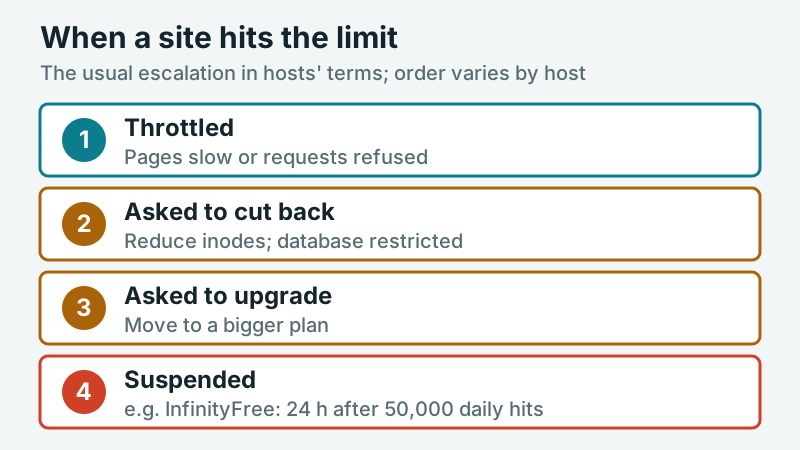
First comes throttling. On CloudLinux-style limits, an account that reaches its CPU, memory or process ceiling is slowed or has extra requests refused, so visitors see slow pages or errors during traffic peaks. GreenGeeks states that overuse is throttled automatically.
Next comes a request. HostGator reserves the right to ask any account holding more than 200,000 inodes to trim them, and databases above its size thresholds may be restricted. DreamHost's resource policy says bandwidth is unmetered but may be temporarily limited, and that sites outgrowing their plan may need to upgrade.
The last step is suspension, usually after warnings. On free "unlimited" hosting it can be immediate: InfinityFree, which markets unlimited bandwidth, caps accounts at 50,000 hits a day and suspends them for 24 hours when that limit is breached.
The practical response at the first sign of throttling is to check what is consuming resources: an unoptimised plugin, a bot crawl, a backup job or a growing cache folder. Fixing the cause is free; the upgrade the host suggests is not.
How many visitors does unlimited hosting really support?
Hosts that publish capacity guides give a better answer than any calculator. DreamHost sizes its Launch plan for about 40,000 monthly visits and says that is a guide, not a hard cap. Bluehost sizes Starter for about 40,000 visits a month, Business for about 200,000 and eCommerce Essentials for about 400,000, and HostGator's Hatchling card also says about 40,000. Hosting.com's Starter plan states 50,000 page views a month.
For bandwidth, a rough estimate helps put "unmetered" in perspective. In the HTTP Archive's 2025 data, the median home page served to phones weighs 2.56 MB. A plan with a 100 GB monthly transfer allowance, such as Hostinger Single, could therefore serve roughly 39,000 uncached loads of a median home page a month (our arithmetic; caching, a CDN and lighter inner pages would raise it a lot). On unmetered plans, CPU and process limits will usually stop a busy site long before bandwidth does.
The honest summary: an unlimited shared plan comfortably handles a typical small business site, a blog or a portfolio, even with tens of thousands of monthly visitors. It is the wrong product for a store with constant concurrent checkouts, a site with heavy search or membership features, or anything that runs long background jobs. Those need a VPS or a managed plan with stated resources.
Unlimited free web hosting
Free hosts use the word too, with tighter real caps. InfinityFree advertises unlimited bandwidth on 5 GB of disk, but limits accounts to 50,000 daily hits, has an inode limit it does not publish, and switches off accounts that see no visitors for somewhere between 20 and 60 days. ByetHost and AeonFree also pair unlimited bandwidth with 5 GB of storage. For a hobby site that is fine; for anything that needs to stay online, our comparison of cheap vs free hosting explains where the cheap tier earns its few dollars.
How to choose an unlimited plan anyway
Unlimited plans are a good deal when you run several small sites, because the per-site cost falls to almost nothing. Choose on the published limits rather than the word:
- Prefer hosts that publish CPU, memory and inode numbers, so you can size the plan before you buy.
- Check the renewal price, because unlimited tiers renew high: $16.99 a month for Hostinger Unlimited and $18.95 for GreenGeeks Pro, both read 9-10 Oct 2026.
- Keep inode use down: clear old backups and cache folders, and move email off the hosting account if it is large.
- Watch the resource graph in the control panel during your busiest week, not your quietest.
Our list of the best cheap web hosting ranks plans by their real long-run cost, and our piece on when cheap hosting bites you covers the warning signs that a site has outgrown shared hosting.
Edge cases
- Email counts against the account: on most shared plans, mailboxes share the same inode and storage pool as the website.
- Backups can quietly fail: Bluehost's terms exclude accounts above 50,000 files or 30 GB from its backups, so a large "unlimited" account may have no host backup at all.
- Staging copies double the footprint: a full staging site counts against inodes and storage too.
- Legacy plans: DreamHost keeps older "Unlimited" customers on a separate legacy policy, so an old account may follow different rules from a new one.
Unlimited hosting questions
Is unlimited web hosting really unlimited?
What is an inode limit in web hosting?
What happens if I exceed my hosting plan's limits?
Is there unlimited free web hosting?
How many websites can I host on an unlimited plan?
See how the hosts compare on true cost: the best cheap web hosting, ranked by renewal price, or run your own numbers in the true-cost calculator.