Month-to-Month Web Hosting in 2026: Monthly vs Annual Cost
Month-to-month web hosting still exists in 2026, but on shared plans it costs roughly four to five times the advertised rate. Hostinger's own guide lists its Unlimited plan at $18.99 a month on a rolling monthly basis, against $3.99 monthly if you prepay 48 months (that plan renews at $16.99). If you will keep the site for more than about ten months, prepaying is cheaper. If you might not, monthly billing is the price of an exit door.
The real surprise is where flexible billing is honest. Unmanaged servers from DigitalOcean, Vultr and Hostwinds charge one monthly rate with no contract and no renewal jump, and managed WordPress host Kinsta charges $35 a month or $30 a month on an annual plan, a gap of two months' fees rather than a multiple. Below: which hosts bill monthly, what they charge, the break-even month, and the refund rules that make monthly plans riskier than they look.
Which hosts still offer month-to-month web hosting
Most big shared hosts will bill you monthly if you look for it, but few publish the price. They put the 36- or 48-month figure on the plan card and leave the monthly rate for the checkout's term selector. The table records what each host states on its own pages (read 9-10 Oct 2026).
| Host and plan | Monthly billing? | Published monthly price | Long-term price and renewal |
|---|---|---|---|
| Hostinger Unlimited | Yes, though it recommends longer plans | $18.99/mo (Hostinger's own guide) | $3.99/mo on 48 months; renews $16.99 |
| DreamHost Launch | Yes, on every web plan | Shown only at checkout | $2.89/mo for 1 year; renews $10.99 |
| Hosting.com Starter | Yes; no lock-ins or minimum terms | Not readable on its pages | Monthly, annual, 36- and 48-month terms |
| HostGator Hatchling | Monthly terms exist | Not published | $3.75/mo on 36 months; renews $10.99 |
| Bluehost Starter | Monthly terms exist | Intro not published; renews at $15.99/mo on monthly terms (Bluehost help page) | $3.99/mo on 36 months; renews $9.99 |
| Kinsta Single 35k | Yes | $35/mo | $30/mo billed annually; no renewal jump |
| DigitalOcean Droplet 1 GiB | Yes, per-second billing | $6/mo cap | Same rate; no term |
| Vultr Cloud Compute 1 GB | Yes, hourly | $5/mo ($0.007/hr) | Same rate; no term |
| Cloudways Micro (1 GB, DigitalOcean) | Yes, hourly | $14/mo ($0.0208/hr) | Same rate; 3-day free trial |
Two groups emerge. Shared hosts (Hostinger, DreamHost, Hosting.com, HostGator, Bluehost, GoDaddy) support monthly terms but price them as a deterrent and, in several cases, strip the refund guarantee from them. Server and cloud providers (DigitalOcean, Vultr, Hostwinds, Cloudways) bill monthly or by the hour as their normal model, so the monthly price is the only price. Hosting.com sits between the two: it offers monthly, annual, 36- and 48-month terms and says plainly that it has no lock-ins or minimum terms, though its prices did not render for us to quote.
Monthly vs annual: the same plan priced different ways
The clearest published comparison is Hostinger's Unlimited plan, because the host gives both numbers itself. On a 48-month term it costs $3.99 a month, paid as $191.52 upfront, and renews at $16.99. On a rolling monthly basis it costs $18.99. That monthly price is higher than the plan's own renewal rate, so a month-to-month customer pays more than a long-term customer ever will, even after the long-term discount ends.
Kinsta's pricing shows the opposite philosophy. Its entry plans list $35 a month on monthly billing, and the annual option works out at $30 a month, which Kinsta describes as two months free compared with paying monthly (pricing page read 10 Oct 2026). There is no intro rate and no renewal jump, so the decision is purely about whether $60 a year is worth the freedom to leave.
DreamHost sits in the middle. Every DreamHost web hosting plan can be billed monthly, but the monthly rates are only shown once you pick the monthly length at checkout. The public number is Launch at $2.89 a month for a prepaid first year, auto-renewing at $10.99. If flexibility matters more than the lowest sticker, DreamHost is the mainstream shared host that makes monthly billing a normal option rather than a hidden one, and it is worth pricing both lengths at its checkout before you decide.
Break-even: when a prepay beats paying monthly
The question that matters is how long you will keep the site. Using Hostinger's two published Unlimited prices, the cumulative cost of each path looks like this:
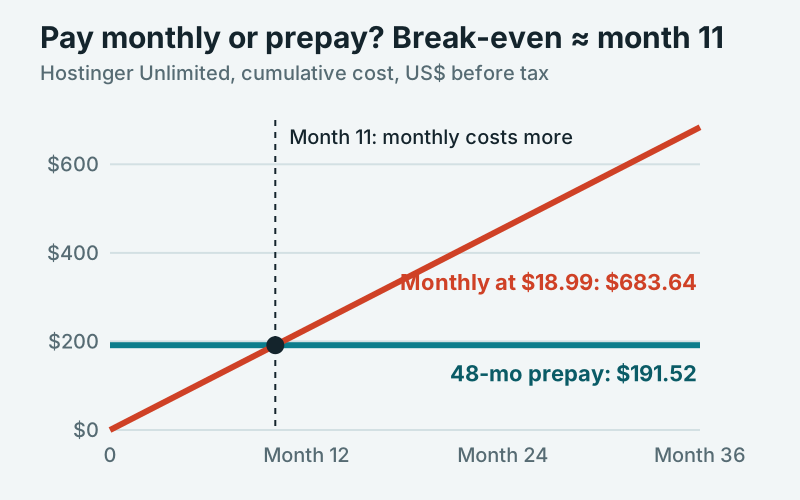
Paying monthly is cheaper for the first ten months: by month 10 you have paid $189.90, just under the $191.52 prepay. From month 11 it costs more, and by month 36 the monthly path has cost $683.64 against $191.52, a difference of $492.12. The prepay also still has a year left to run at that point.
So the rule of thumb is about ten months. If there is a real chance the site will not survive its first year (a test business, an event page, a client project with an end date), monthly billing is the rational choice despite the price. If the site is a long-term home, the prepay wins quickly, provided you are confident enough in the host to commit. If that describes you, Hostinger's 48-month terms are the cheapest way to own the plan, and its 30-day refund window gives you a month to back out.
One more wrinkle works in the prepay's favour. Hostinger's refund policy lets you cancel a hosting purchase within 30 days (domain renewals and some add-ons are excluded), so the first month of a long prepay carries little risk. The risk starts on day 31, when the money is committed for years.
The hidden costs of paying monthly
The higher rate is only part of what monthly billing costs on shared hosting. The terms add three more.
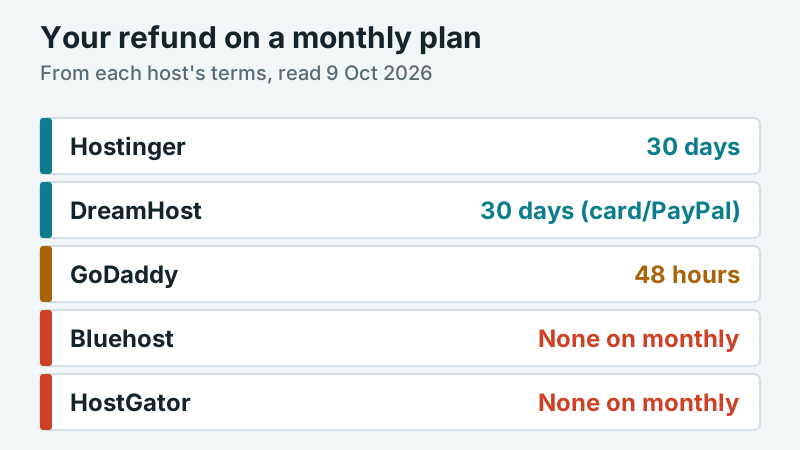
- No refund. Bluehost's terms exclude monthly-term products from its 30-day refund, and HostGator's exclude "Services with a monthly term" from its money-back guarantee. GoDaddy's refund policy gives monthly plans 48 hours, against 30 days for annual ones (revised 14 Sep 2026; GoDaddy notified some customers of a further change from 15 Oct 2026, so check the current terms).
- No free domain. Bluehost includes the first-year domain only with 12- or 36-month plans, and Hostinger's free domain needs a plan of 12 months or more. On monthly billing, budget for the domain separately.
- Setup fees. Several hosts mention setup fees in their terms without publishing the amount: Bluehost and HostGator list them as non-refundable, and GreenGeeks deducts them from refunds. Ask at checkout whether a monthly term triggers one.
There is also a reason you rarely read about monthly billing on review sites. Hostinger's affiliate agreement pays no commission on 1-month plans, only on initial purchases of 12 months or more. That incentive applies to any site that earns from Hostinger referrals, this one included if its link is approved, which is why we flag it: it explains why the monthly option is so hard to find in hosting coverage. Our affiliate disclosure explains how we are paid.
True month-to-month: VPS and cloud billing
If you want genuine pay-as-you-go hosting, look past shared plans. DigitalOcean's Basic Droplets cost $4 a month for 512 MiB of memory and $6 for 1 GiB, charged by the second (with a one-minute minimum), and the listed monthly price acts as a ceiling. Vultr's regular cloud servers start at $5 a month for 1 GB, or $0.007 an hour. Hostwinds lists unmanaged Linux VPS plans from $4.99 a month with no intro or renewal split on the page. Cloudways, which manages cloud servers for you, charges $14 a month for its 1 GB DigitalOcean server, billed hourly, with a three-day free trial that needs no card.
These are honest monthly prices: what you pay in month one is what you pay in month thirty. The trade is that an unmanaged server is your job to set up, secure and update. If you can run one, a $5 or $6 server billed monthly is cheaper than most shared hosts' renewal rates and far cheaper than their monthly rates.
Who should pay monthly anyway
Monthly billing is worth its premium in a handful of situations:
- Short-lived sites: an event, a campaign, a prototype or a client handover where the site will move within months.
- Testing a host beyond its refund window, when 30 days is not enough to judge support or performance under real traffic.
- Tight cash flow, where $18.99 this month is affordable and $191.52 today is not.
- Developers who already manage servers and can use a per-second or hourly VPS instead.
For everyone else, the better pattern is to buy a 12-month term from a host with a low renewal, use the 30-day refund window as your trial, and extend only once you are sure. Our true-cost calculator compares any term against any renewal, our guide to getting the lowest hosting price covers coupons and term tricks, and our ranked list of cheap web hosting is sorted by what each plan costs after the promo.
Edge cases
- Upgrading the term later: many hosts let a monthly customer switch to a long term, but the long-term price offered at that point may not be the new-customer promo. Check before relying on it.
- Monthly renewals on a long-term plan: some hosts let a prepaid plan renew monthly at the end of its term. That keeps flexibility, but at the monthly rate, which can exceed the annual renewal.
- Taxes: monthly charges attract sales tax or VAT each month, just as a prepay does upfront; the comparison above is before tax.
- Free tiers are not monthly plans: platforms such as Vercel restrict their free Hobby plan to non-commercial personal use, which rules out affiliate sites and businesses.
Month-to-month hosting questions
Can you pay for web hosting monthly?
Is monthly web hosting more expensive than annual?
What is the cheapest month-to-month web hosting?
Do monthly hosting plans come with a money-back guarantee?
How long before a hosting prepay pays off?
See how the hosts compare on true cost: the best cheap web hosting, ranked by renewal price, or run your own numbers in the true-cost calculator.